
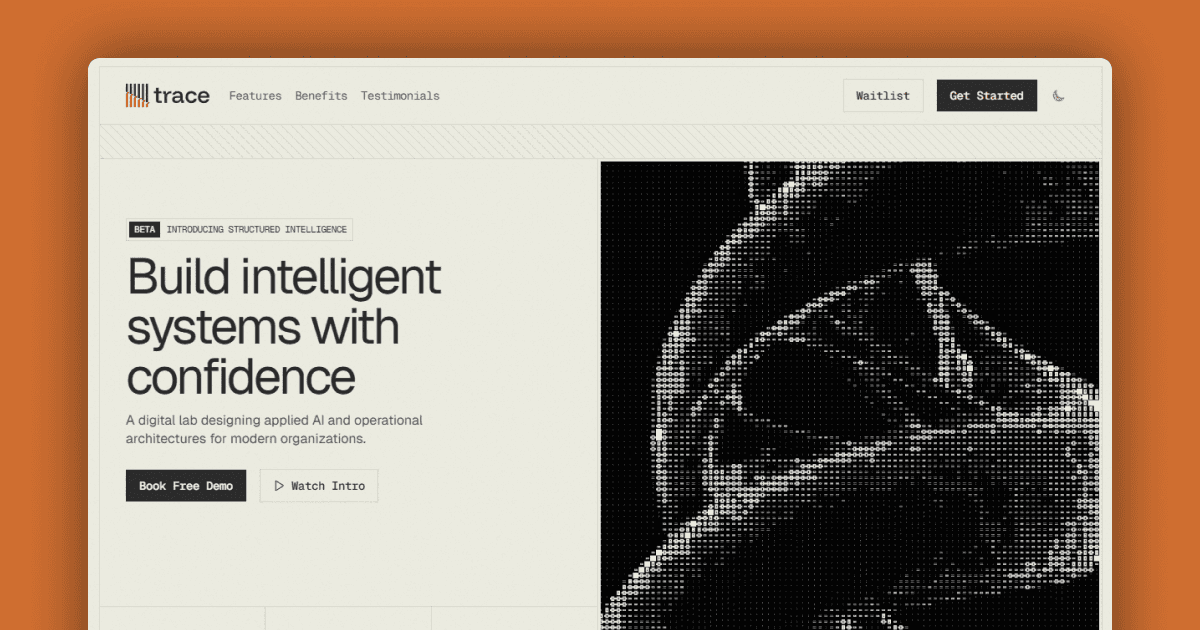
What is Trace?
Trace is a cutting-edge operational layer designed to integrate AI agents with human judgment, streamlining workflows across various departments within an organization. It tackles the challenge of modern business complexity by ensuring seamless interaction between AI functionality and human oversight, thereby enhancing productivity and operational clarity. For teams overwhelmed by fragmented workflows and disjointed communication channels, Trace offers a much-needed solution that fosters collaboration and alignment, ultimately unlocking new levels of efficiency and output.
The core workflow of Trace revolves around its Context Engine, which understands how tasks flow between departments. By building a persistent model of your organizational operations, the platform allows teams to automate routine tasks while maintaining control over critical processes. Users can connect existing tools like Slack, Notion, and Google Drive to Trace, enabling a comprehensive integration that captures all relevant data points. This environment facilitates adaptive AI agents that not only execute predefined tasks but also learn to optimize workflows over time, reducing operational friction significantly.
Key features of Trace include adaptive AI agents that can seamlessly operate within real-world workflows, ensuring that tasks progress with the correct context. Full traceability of actions taken by both AI agents and human users allows for constant oversight, which is crucial for maintaining accountability and understanding workflow dynamics. Additionally, the platform provides clear visibility into all operations, so that organizations can measure the effectiveness of their workflows and make informed adjustments where necessary. Adaptive AI agents work alongside human operatives, allowing businesses to automate mundane tasks while reserving critical decision-making functions for their teams.
Trace is ideally suited for modern organizations operating at scale, particularly those who are managing complex and interdepartmental workflows. Businesses such as sales teams, client onboarding departments, and finance units can leverage Trace to minimize delays, improve accuracy, and enhance communication throughout their operations. For instance, sales teams can automate lead qualification and follow-up processes, while finance departments can streamline contract review and approval tasks. This tool proves vital for startups aiming for rapid scaling without a corresponding increase in staffing, as it enhances productivity while preserving operational oversight.
In comparison to other tools in the AI automation space, Trace stands out by providing an orchestration layer that not only automates tasks but also incorporates human insights into those processes. Many existing solutions might focus solely on automating repetitive tasks without full visibility or consideration of operational context, leading to potential misalignments. By structuring workflows that incorporate both AI functionality and human judgment, Trace ensures that automation is executed intelligently, offering a clear advantage.
However, Trace is currently in its beta stage, and users might encounter limitations such as occasional glitches or incomplete functionality as the tool is refined and improved. Additionally, while integration is facilitated with many existing tools, organizations heavily reliant on less common platforms may encounter integration challenges. The potential learning curve for teams adopting this new operational framework could also pose a barrier to immediate implementation, necessitating a period of adjustment to fully utilize its capabilities.
Who it's for
Works with
What Trace can do
8 capabilities, verified from the product.
- Integrates with existing tools
- Automates complex workflows
- Adaptive AI agents for operational tasks
- Human–AI collaboration
- Full traceability of workflows
- Real-time task management
- Context-aware automation
- Supports scale without losing control
Jobs people hire it for
- 01Streamline client onboarding processes
- 02Automate lead qualification and follow-ups
- 03Efficiently manage sales pipeline tasks
- 04Enhance contract review and approval workflows
- 05Optimize team collaboration across departments
Pros & cons
Where it shines
- Trace facilitates clarity at scale, making complex operations easier to manage.
- It significantly reduces operational friction by automating routine tasks.
- Its adaptive AI agents enhance decision flows by processing contextual information.
- The platform provides full traceability, ensuring accountability within workflows.
Where it falls short
- As a beta product, it may exhibit instability and bugs during its development.
- Some users might face integration issues with less common tools.
- There could be a learning curve for teams new to automation frameworks, prolonging early adoption.
Pricing
See the official website for current pricing. Pricing can change — always confirm on the vendor's site.
Frequently asked about Trace
What is Trace and what problem does it solve?
Trace is an AI orchestration layer designed to integrate AI agents with human judgment across teams. It solves the problem of fragmented workflows and communication, offering a solution that enhances operational clarity and collaboration.
How does Trace work?
Trace connects with existing tools and communication channels to create a model of operational workflows. It deploys adaptive AI agents to automate tasks while ensuring human oversight through a context-aware approach.
Is there a free version or pricing details available?
Trace is currently in beta and does not have specific pricing details available; prospective users are encouraged to contact the team for more information.
What types of organizations benefit from using Trace?
Trace is ideal for teams and organizations managing complex workflows, such as sales, finance, and operations, looking to increase efficiency and clarity without proportionally scaling their workforce.
What integrations does Trace support?
Trace supports integrations with popular tools like Slack, Notion, Jira, Google Drive, and HubSpot, allowing organizations to leverage existing infrastructure.
What are the key features of Trace?
Trace provides features such as adaptive AI agents, human-AI orchestration, full traceability, seamless integration, and real-time task management, optimizing operational workflows.
What are the limitations of using Trace?
As a beta product, Trace may have stability issues and a potential learning curve for new users, with some limitations on integrations with less common platforms.
How does Trace differ from other AI automation tools?
Trace differs by offering a structured orchestration layer that combines AI automation with human insights, ensuring that automation is intelligently executed and aligned with operational context.
Ready to try Trace?
1,550 people checked it out on the directory — see it in action on the official site.
Keep exploring
Similar tools in Productivity & Agents
 Productivity & Agents
Zapier Agents
No-code AI agents that work across 7,000+ apps — automation that thinks.
 Productivity & Agents
Reclaim AI
An AI calendar that defends your focus time and schedules your tasks automatically.
 Productivity & Agents
Maestro Labs
AI tools for Outlook, Teams & Office, enhancing productivity in Microsoft 365.
 Productivity & Agents
Studyable
AI-powered study app offering instant homework help and flash cards.