
Sully.ai
Superhuman AI assistants to streamline hospital operations
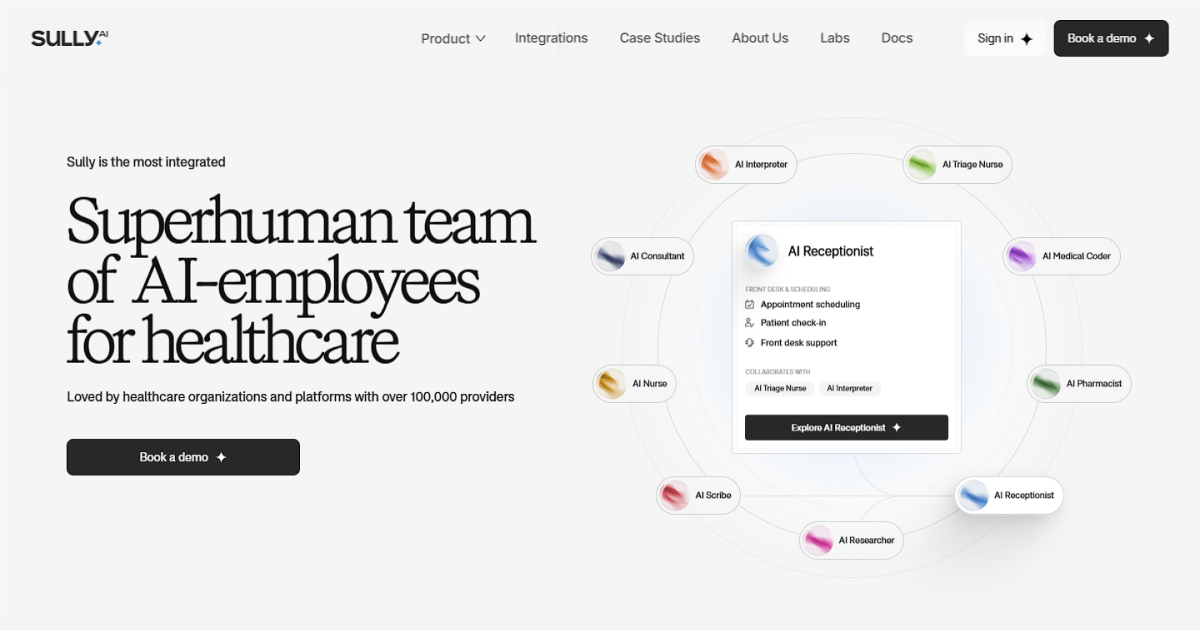
What is Sully.ai?
Sully.ai provides a suite of AI-driven assistants designed to transform operational efficiency in hospitals. With specialized agents functioning as triage nurses, receptionists, scribes, medical coders, pharmacists, and interpreters, Sully.ai addresses the escalating demands on healthcare providers, thereby saving time and improving patient care. The platform integrates seamlessly into existing healthcare workflows, alleviating the burdens that lead to burnout among medical professionals. By automating routine tasks, healthcare staff can refocus their efforts on patient interactions and clinical outcomes, enhancing overall hospital productivity and care quality.
The core workflow of Sully.ai begins with the deployment of AI agents embedded in various hospital functions. These agents autonomously handle tasks such as appointment scheduling, patient check-in, and documentation by converting real-time interactions into structured notes. For instance, the AI Scribe captures conversations during patient visits, significantly reducing after-hours charting for clinicians. Complementing the scribe function is the AI Medical Coder, which boosts billing accuracy through autonomous coding, thus minimizing revenue loss from missed or incorrect coding. Each agent is built on specialized language models that understand medical terminologies and clinician workflows, ensuring they resonate well with the clinical staff they aim to assist.
Sully.ai boasts capabilities that set it apart in the health tech landscape. Its real-time patient engagement tools increase interaction efficiency, with AI agents improving operational metrics significantly—like a reported 98% drop in call abandonment rates. Moreover, the AI Medical Consultant offers tailored medical advice, ensuring that clinicians maintain a high standard of care without being overwhelmed by operational tasks. Integration with major EHR systems like Epic and Cerner allows Sully.ai to manage data efficiently without disrupting existing practices, thereby facilitating a smoother transition and faster implementation in healthcare environments.
This tool is particularly beneficial for hospitals and clinics that are looking to enhance operational efficiency and reduce administrative burdens. Busy healthcare environments with high patient volumes would find Sully.ai invaluable, especially in specialties involving extensive patient interactions, such as primary care, urgent care, and specialty clinics. Additionally, healthcare administrators seeking to reduce staff burnout while improving patient satisfaction will find that the use of Sully.ai directly correlates to better morale and productivity in clinical teams.
In terms of market positioning, Sully.ai is prominent for its focus on continuous improvement and learning through its AI agents. Its innovative approach harnesses specialized machine learning models that surpass traditional AI applications in accuracy and efficacy, making it a strong competitor against other healthcare automation solutions. The technology is purpose-built with healthcare compliance in mind, ensuring that security measures like HIPAA and GDPR are prioritized, which is a critical consideration in patient data management.
While Sully.ai presents numerous advantages, users may want to consider potential limitations. The reliance on AI agents to handle patient interactions requires a robust underlying technology, and any system discrepancies could impact performance. Furthermore, continuous training and updates of these AI models are essential to maintain their effectiveness, which could pose a resource challenge. Lastly, the initial setup and integration process, though seamless, may require valuable time and stakeholder engagement to ensure that all components are harmonized with existing systems. Overall, Sully.ai represents a leap forward in how technology can support healthcare professionals while enhancing patient care experience, but organizations must be prepared for the transitional dynamics that come with such innovative tools.
Who it's for
Works with
What Sully.ai can do
8 capabilities, verified from the product.
- AI Scribe for real-time note-taking
- Autonomous medical billing and coding
- Seamless EHR integration with major platforms
- Real-time patient engagement and check-in
- Full compliance with HIPAA and GDPR
- Built-in feedback and response tools
- Automated appointment scheduling capabilities
- Supports multiple roles: Nurse, Receptionist, Coder
Jobs people hire it for
- 01Automate patient appointment scheduling and check-ins
- 02Reduce clinician burnout by automating documentation tasks
- 03Enhance billing accuracy with autonomous coding
- 04Improve patient engagement with timely follow-ups
- 05Streamline front desk operations through AI assistants
Pros & cons
Where it shines
- Sully.ai significantly increases operational efficiency by automating routine tasks
- The AI agents improve patient engagement by ensuring timely and accurate interactions
- Integration with major EHR systems allows for a seamless workflow transition
- The platform is designed with compliance and security as top priorities, meeting necessary regulatory standards
Where it falls short
- Initial setup and integration might require considerable time investment
- Reliance on AI may create challenges if system discrepancies arise
- Continuous model training is essential for sustained effectiveness
- Adoption may face resistance from staff accustomed to traditional workflows
Pricing
See the official website for current pricing. Pricing can change — always confirm on the vendor's site.
Frequently asked about Sully.ai
What types of AI agents does Sully.ai offer?
Sully.ai provides multiple specialized AI agents, including a Nurse, Receptionist, Medical Scribe, Coder, and Pharmacist, each designed to address specific operational needs in healthcare settings.
How does Sully.ai ensure compliance with healthcare regulations?
Sully.ai is designed to comply with healthcare regulations such as HIPAA and GDPR. Compliance is maintained through data encryption, access controls, audit logging, and continuous monitoring.
Can Sully.ai integrate with existing healthcare systems?
Yes, Sully.ai integrates seamlessly with major EHR systems, such as Epic and Cerner, ensuring that AI agents work within existing workflows without disruption.
Who can benefit from using Sully.ai?
Hospitals and clinics with busy practices can benefit the most from Sully.ai, especially those seeking to enhance operational efficiency, reduce administrative burdens, and improve clinician well-being.
What is the primary goal of Sully.ai?
The primary goal of Sully.ai is to automate routine tasks in healthcare, enabling clinicians to focus more on patient care and reducing burnout among healthcare professionals.
Ready to try Sully.ai?
2,083 people checked it out on the directory — see it in action on the official site.
Keep exploring
Similar tools in Productivity & Agents
 Productivity & Agents
Zapier Agents
No-code AI agents that work across 7,000+ apps — automation that thinks.
 Productivity & Agents
Reclaim AI
An AI calendar that defends your focus time and schedules your tasks automatically.
 Productivity & Agents
Maestro Labs
AI tools for Outlook, Teams & Office, enhancing productivity in Microsoft 365.
 Productivity & Agents
Studyable
AI-powered study app offering instant homework help and flash cards.