
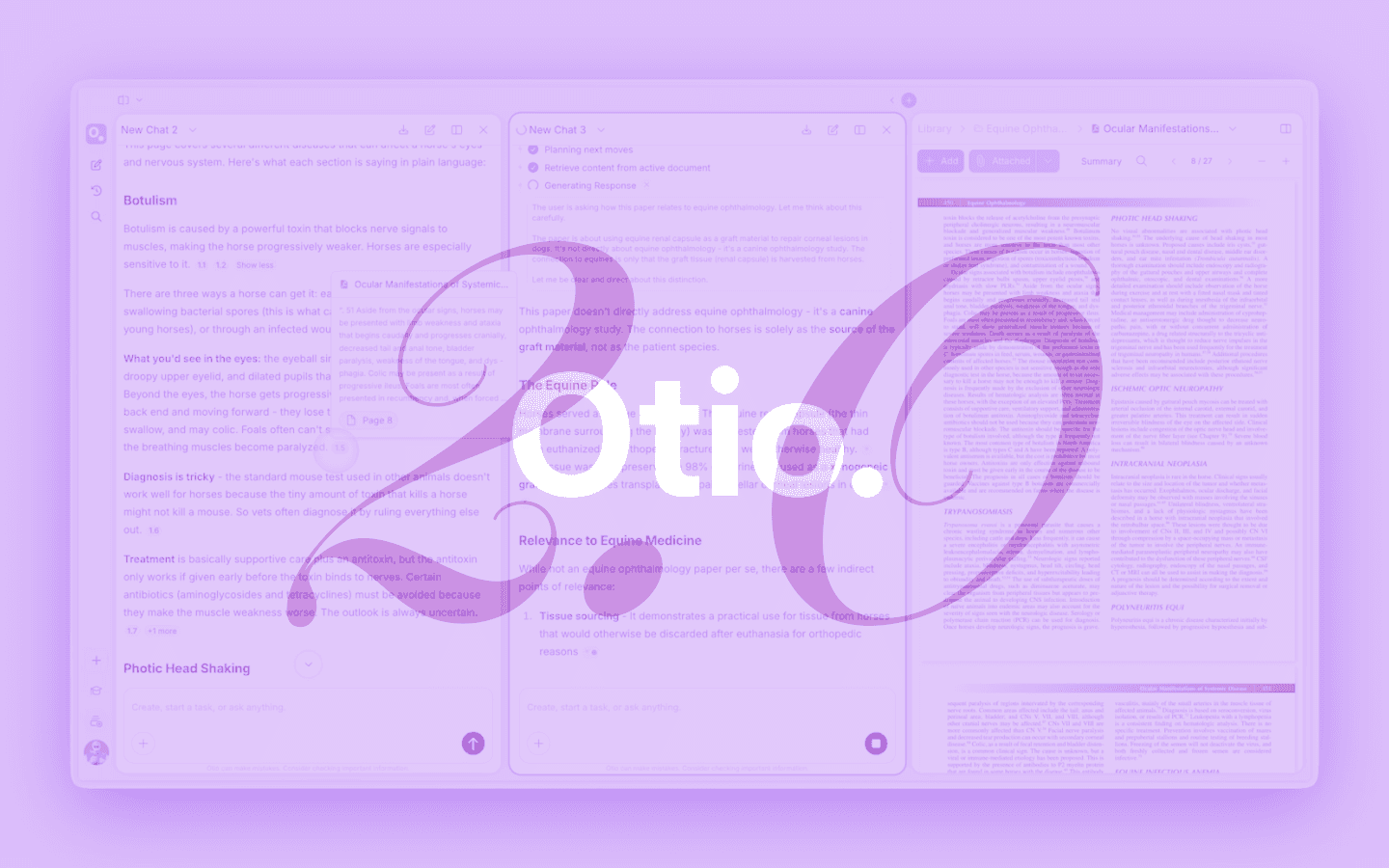
What is Otio?
Otio is a state-of-the-art AI research assistant and writing partner designed specifically to streamline the complex workflows of researchers. It enables users to efficiently gather insights, synthesize information from diverse sources, and automate tedious tasks that often occupy significant amounts of time in the research process. By utilizing advanced AI technology, Otio not only accelerates learning but also enhances the quality of analysis and output, making it an essential tool for professionals across various fields, including academia, legal, financial analysis, and more.
The core functionality of Otio revolves around its ability to read and summarize a vast range of content types, from PDFs and web pages to YouTube videos and podcasts. Users can upload multiple sources, and Otio will distill key findings, themes, and contradictions across the submitted material. This allows researchers to bypass the lengthy process of sorting through mountains of data, giving them instant access to structured summaries that can serve as the foundation for further writing and analysis. Furthermore, all answers provided by Otio are fully cited, ensuring that users can trust and verify the information against the original sources effortlessly.
Among Otio’s standout capabilities is the AI PDF Reader, which not only extracts information from PDF documents but also utilizes AI OCR techniques for high-quality text extraction from scanned or image-based documents. The AI Book Summarizer and AI Podcast Summarizer are particularly useful for academics and writers looking to condense large volumes of content into manageable summaries. These features collectively enable users to keep their research organized by maintaining individual workspaces tailored to specific projects, allowing them to manage and query their research over time without the limitations often imposed by other AI tools.
Otio is ideal for a diverse array of users, including but not limited to researchers, consultants, lawyers, data analysts, and creative writers. For instance, an academic researcher can upload multiple academic papers to facilitate a literature review, drawing key findings without undergoing hours of reading. Similarly, a policy analyst can submit client briefs or meeting transcripts and generate concise summaries equipped with essential themes and points ready for presentation. With the flexibility to synthesize diverse content forms, Otio empowers professionals to build a robust repository of knowledge and insights that evolve as their research projects progress.
When compared to other AI research tools such as ChatGPT, Otio offers a unique advantage in that it maintains a permanent archive of uploaded materials while allowing users to draw insights consistently from these sources. Unlike similar platforms that limit the number of documents or reset sessions, Otio's design facilitates ongoing research projects over extended periods. Users can revisit and refine their queries and insights over weeks or months, significantly improving productivity and reducing the cognitive load associated with managing multiple information streams.
However, despite its advanced functionalities, Otio still has its limitations. Users may find a potential learning curve in mastering all the features and workflows, particularly those who are new to AI-assisted research tools. Additionally, while Otio supports multiple AI models and diverse content types, there may still be content formats or features not covered exhaustively within the platform. Maintaining connectivity and stability while handling complex queries can also present challenges, particularly for intensive data projects that require high responsiveness from the software. Understanding these nuances is crucial for new users to maximize Otio's potential in their research endeavors.
Who it's for
Works with
What Otio can do
8 capabilities, verified from the product.
- AI PDF Reader for text extraction
- Multiple AI models for flexible queries
- AI Book and Textbook Summarizer
- AI Podcast and YouTube Video Summarizer
- Webpage Summarizer for online content
- Spreadsheet AI for data visualization
- Context-aware chat for nuanced assistance
- Verified citations for all generated insights
Jobs people hire it for
- 01Streamline literature reviews by summarizing multiple papers
- 02Extract key themes from legal documents efficiently
- 03Generate structured summaries from client meeting notes
- 04Create visual data representations from spreadsheets
- 05Compile thematic arguments from various media sources
Pros & cons
Where it shines
- Offers comprehensive support for various content types including PDFs and audiovisual materials.
- Allows continuous research accumulation without losing past material due to session resets.
- Facilitates a structured synthesis process that accelerates writing and data analysis.
- Citations are linked to original sources, enhancing trustworthiness of information.
Where it falls short
- Potential learning curve for new users unfamiliar with AI-driven tools.
- Limited support for niche content formats that might not be covered out-of-the-box.
- May require high responsiveness from infrastructure for complex queries to avoid lag.
Pricing
Free
/mo
Free access to all basic features, ideal to get started.
Free to start with advanced features available on a paid tier Pricing can change — always confirm on the vendor's site.
Frequently asked about Otio
Can I trust Otio to give me accurate information?
Yes, Otio is designed to work with your sources directly. It generates answers based solely on the material you've uploaded, providing exact citations for every claim made. This ensures that all information can be verified against the original sources, making it a reliable tool for research.
Why wouldn't I just use ChatGPT?
While ChatGPT is a versatile conversational AI, it does not maintain a permanent context across sessions nor can it accumulate research like Otio. Otio enables you to upload and organize sources over time, allowing for continuous inquiry and thus fostering a deeper understanding of ongoing research projects.
What is the pricing model and is there a free plan?
Otio offers a free starting plan that includes access to all features, allowing users to explore its capabilities before considering any premium options.
What types of sources can I use with Otio?
You can use a variety of sources with Otio, including PDFs, online articles, YouTube videos, podcasts, and webpages. This flexibility allows users to draw insights from multiple content types and formats.
Is Otio only for academic research?
No, while Otio is exceptionally useful for academic purposes, it is also tailored for professionals in fields such as law, policy analysis, and other industries where structured research and synthesis are essential.
How does Otio cite its answers?
Otio cites every answer precisely back to the original source from which the information was derived. This citation method ensures that users can quickly verify the context and accuracy of the information.
Can I use multiple AI models in Otio?
Yes, Otio supports the use of multiple AI models, allowing users to leverage different capabilities in their research depending on the types of work or inquiries they need to address.
How many sources can I upload to Otio?
Otio allows for a significant number of sources to be uploaded without imposing strict limits, enabling users to manage comprehensive research databases over time.
Ready to try Otio?
1,803 people checked it out on the directory — see it in action on the official site.
Keep exploring
Similar tools in Productivity & Agents
 Productivity & Agents
Zapier Agents
No-code AI agents that work across 7,000+ apps — automation that thinks.
 Productivity & Agents
Reclaim AI
An AI calendar that defends your focus time and schedules your tasks automatically.
 Productivity & Agents
Maestro Labs
AI tools for Outlook, Teams & Office, enhancing productivity in Microsoft 365.
 Productivity & Agents
Studyable
AI-powered study app offering instant homework help and flash cards.