
Fluid Topics
Unify and deliver product knowledge efficiently with AI-driven experiences.
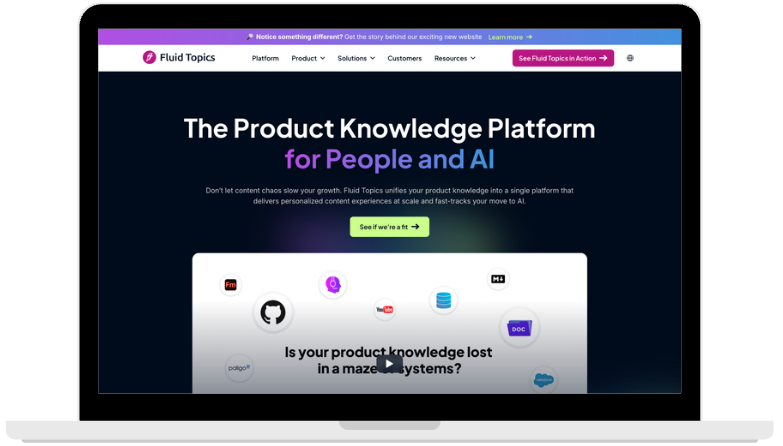
What is Fluid Topics?
Fluid Topics is a cutting-edge Product Knowledge Platform designed to help organizations streamline their documentation and knowledge-sharing processes. In today's digital landscape, fragmented content can significantly impede productivity and informed decision-making. Fluid Topics addresses this challenge by centralizing all product-related content into a unified platform that ensures accessibility, reliability, and contextually relevant information for users. The platform stands out by enabling organizations to leverage their existing knowledge into AI-ready content, thus enhancing the overall user experience while paving the way for advanced AI integrations.
Fluid Topics operates by transforming traditional documentation into a dynamic resource accessible to both users and AI systems. The workflow begins with content creation, where organizations can generate documentation through their preferred tools. Fluid Topics then plays a crucial role in distributing this content efficiently across various digital channels. This process ensures that critical updates or changes in product information are reflected in real-time, maintaining a seamless flow of accurate data. The platform further simplifies AI readiness by enriching existing content, effectively preparing it for integration with AI applications and autonomous agents, which helps to automatically deliver personalized content experiences to end-users.
One of the standout capabilities of Fluid Topics is its AI-powered search functionality, which ensures that every search conducted by users yields contextual and precise results regardless of the content type or source. This tailored search capability significantly enhances self-service options, allowing users to quickly find the information they need without navigating through disjointed content. Additionally, the platform offers an intuitive Portal Designer, enabling users to create custom content delivery portals quickly. This feature empowers organizations to manage their branding, layout, and content organization with ease, resulting in a user-friendly environment that fosters engagement and efficient knowledge retrieval.
Fluid Topics is particularly beneficial for a range of audiences, including documentation teams, CIOs, IT leaders, customer support departments, and field service teams. For documentation teams, Fluid Topics streamlines content operations, allowing them to focus on high-value tasks while optimizing workflows. IT leaders gain the ability to leverage AI securely within a structured framework that transforms content into engaging experiences. Meanwhile, customer support teams see a marked increase in user satisfaction and a significant reduction in support calls through 24/7 personalized self-service options. This flexibility extends to field service workers, who can access essential documentation in real-time, thus improving task efficiency and compliance with service level agreements.
In terms of competitive positioning, Fluid Topics differentiates itself by providing not just a documentation portal but a holistic product knowledge solution. It integrates seamlessly with various existing systems, boasting connectors to tools like Adobe Experience Manager, Salesforce, and Zendesk. This compatibility enhances its value proposition, allowing organizations to incorporate Fluid Topics into their current tech stacks without extensive overhauls.However, potential users should be aware of some limitations. Organizations need to invest time in initial setup and integration to fully realize the platform's capabilities. Users might also face a learning curve when adapting to the customizations available in the Portal Designer and the intricacies of AI integrations. Overall, Fluid Topics presents a robust option for organizations looking to modernize their knowledge-sharing processes while harnessing AI-driven efficiencies.
Who it's for
Works with
What Fluid Topics can do
10 capabilities, verified from the product.
- Centralizes fragmented product content
- Transforms traditional docs into AI-ready content
- Intuitive Portal Designer for custom portals
- AI-powered semantic search for contextual results
- Real-time analytics to track content usage
- Multi-format content delivery (text, audio, video)
- Prebuilt chatbot orchestration and integrations
- Contextual in-product help for user guidance
- Robust content management with role-based access
- Integrates with numerous established platforms
Jobs people hire it for
- 01Accelerate documentation delivery process for rapid product updates
- 02Enhance customer self-service with intuitive help portals
- 03Deploy AI chatbots for real-time, context-aware support
- 04Provide in-product assistance to streamline user onboarding
- 05Gather analytics on content performance to optimize resources
Pros & cons
Where it shines
- Fluid Topics unifies fragmented content into a centralized platform, enhancing overall accessibility.
- The platform enriches existing documentation, turning it into AI-ready content without extensive additional work.
- Users can customize their content delivery portals, offering a tailored experience while maintaining brand identity.
- Advanced AI search functionality delivers precise, contextual results, improving user satisfaction and self-service capabilities.
- Real-time analytics provide actionable insights to continuously improve documentation and user engagement.
Where it falls short
- Initial setup and integration may require significant time investment to fully leverage the platform's capabilities.
- New users might experience a learning curve with the platform's extensive customization options.
- While well-integrated, businesses may need to adjust existing workflows to utilize Fluid Topics effectively.
- Continual reliance on the platform may necessitate regular content updates to maintain relevance and accuracy over time.
Pricing
See the official website for current pricing. Pricing can change — always confirm on the vendor's site.
Frequently asked about Fluid Topics
What does Fluid Topics do?
Fluid Topics is a Product Knowledge Platform designed to centralize fragmented product content and transform it into AI-ready documentation. It enables organizations to deliver personalized content experiences while improving user engagement and operational efficiency.
How does the platform enhance content delivery?
Fluid Topics centralizes all product-related content into a single hub, allowing documentation teams to create content once and deliver it seamlessly across all digital channels. This ensures that users always receive the latest, most accurate information.
Is there an AI component in Fluid Topics?
Yes, Fluid Topics incorporates AI capabilities, enabling organizations to leverage their existing knowledge for AI applications. It features AI-powered semantic search, chatbot integrations, and tools for creating contextually aware responses.
Who is Fluid Topics best suited for?
Fluid Topics is suitable for a range of audiences, including documentation teams seeking to optimize their content operations, IT leaders looking to implement AI securely, customer support teams wanting to enhance self-service options, and field service groups needing real-time access to resources.
Can it integrate with other tools and platforms?
Absolutely, Fluid Topics offers integrations with numerous popular platforms such as Salesforce, Zendesk, Adobe Experience Manager, and GitHub. This allows organizations to embed Fluid Topics into their existing tech stack seamlessly.
What are the initial expectations for setup and use?
Users should expect some initial setup and integration time to maximize Fluid Topics' capabilities. Additionally, navigating the customization features may require a learning curve, particularly for new users.
What types of content formats does Fluid Topics support?
Fluid Topics supports various content formats, including text, audio, video, and interactive elements, allowing organizations to serve information in multiple engaging ways.
Ready to try Fluid Topics?
1,106 people checked it out on the directory — see it in action on the official site.
Keep exploring
Similar tools in Productivity & Agents
 Productivity & Agents
Zapier Agents
No-code AI agents that work across 7,000+ apps — automation that thinks.
 Productivity & Agents
Reclaim AI
An AI calendar that defends your focus time and schedules your tasks automatically.
 Productivity & Agents
Maestro Labs
AI tools for Outlook, Teams & Office, enhancing productivity in Microsoft 365.
 Productivity & Agents
Studyable
AI-powered study app offering instant homework help and flash cards.