
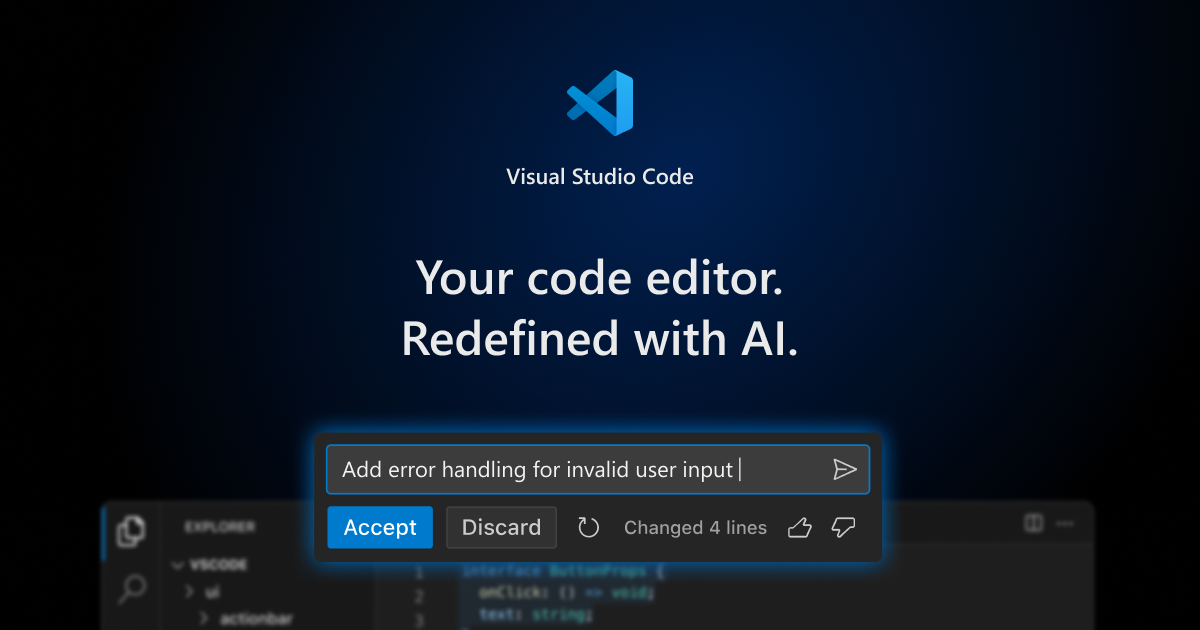
What is Visual Studio Code?
Visual Studio Code (VS Code) is a versatile, open-source code editor developed by Microsoft that integrates development tools with AI capabilities, tailored to streamline coding through multi-agent workflows. It addresses the needs of modern developers by combining a robust coding environment with intelligent tools and features designed to enhance productivity and reduce errors. The editor supports various programming languages and offers a wide range of extensions, making it an indispensable tool for software development in any environment. Its capacity to support AI agents allows users to automate tasks, plan, code, and debug seamlessly, thus alleviating some of the most tedious aspects of development work.
The core workflow of VS Code centers around its powerful customization and extensibility. At its heart, VS Code allows users to write and edit code in a highly responsive environment that can be tailored for any project. Developers can choose from built-in support for popular languages like JavaScript, TypeScript, HTML, and CSS, while additional language support can be added through extensions accessed from the VS Code Marketplace. Moreover, AI agents can be integrated to enhance productivity; these agents can automate repetitive tasks, offer real-time suggestions, and help manage code changes, drastically improving workflow efficiency.
Among its standout features, VS Code boasts rich language support, intelligent code completion powered by AI, built-in Git integration, a customizable user interface, and a vast library of extensions. The integration of an integrated terminal allows developers to run commands without leaving the editor, and the built-in debugging tools facilitate troubleshooting directly within the environment. The support for user profiles and settings synchronization ensures that developers can maintain their preferences across different machines, making it a highly flexible solution. The platform also emphasizes collaboration features, with capabilities like Live Share allowing developers to remote-pair program and share their development sessions in real time.
VS Code appeals to a wide range of audiences, including professional developers, hobbyists, educators, and students. It is particularly beneficial for those who work with diverse programming languages or those who require a collaborative development environment. Professional teams can leverage VS Code to maintain coding standards and workflows, while students and educators may find its ease of use and robust feature set conducive for learning programming concepts. Typical scenarios where VS Code shines include building full-stack applications, developing web applications, and creating scripts for automation.
In the landscape of development tools, VS Code distinguishes itself by being free and open-source, offering unparalleled flexibility through its extensibility. Its capability to seamlessly integrate AI agents into the development cycle sets it apart from traditional code editors, further enhancing its usability. Furthermore, its support for multiple platforms (Windows, macOS, and Linux) allows developers to work across different environments without being tied to a specific OS, fostering greater accessibility.
Despite its extensive features, VS Code does come with considerations. Beginners may face a steeper learning curve due to its myriad of functionalities and customization options, which may seem overwhelming at first. While the abundance of extensions greatly enhances its capability, it also requires users to manage and filter through potentially conflicting or unnecessary tools. Additionally, while the AI functionalities can significantly boost productivity, they depend heavily on user input and may require initial setup to tailor them effectively to specific development tasks or workflows.
Who it's for
What Visual Studio Code can do
8 capabilities, verified from the product.
- Multi-agent development for automation
- Support for all major programming languages
- Extension Marketplace with 80,000+ extensions
- Integrated terminal for command execution
- Built-in Git support for version control
- Intelligent code suggestions and autocompletions
- Customizable UI and theme options
- Settings sync across devices for user preferences
Jobs people hire it for
- 01Automate coding tasks using AI agents
- 02Debug applications in real-time
- 03Develop full-stack web applications
- 04Collaborate with teams using Live Share
- 05Use version control directly within the editor
Pros & cons
Where it shines
- Highly versatile with support for various programming languages
- Robust extension ecosystem that enhances functionality
- AI integrations significantly improve coding efficiency
- Cross-platform availability ensures accessibility on any device
Where it falls short
- May overwhelm new users with its extensive features
- Some extensions could conflict or be redundant
- Requires initial configuration to optimize AI features for specific workflows
Pricing
Free to use with no trials or credit card required Pricing can change — always confirm on the vendor's site.
Frequently asked about Visual Studio Code
What is Visual Studio Code?
Visual Studio Code is a free, open source code editor developed by Microsoft that incorporates AI functionalities for enhancing coding efficiency. It provides a robust and flexible environment for developers to write, edit, and debug code.
Is Visual Studio Code really free?
Yes, Visual Studio Code is completely free to use. There are no hidden costs, trials, or credit card requirements.
What programming languages does VS Code support?
VS Code supports all major programming languages such as JavaScript, TypeScript, CSS, HTML, Java, C++, Python, and more. Many additional languages and tools can be integrated through extensions from the marketplace.
How does VS Code handle multi-agent development?
VS Code facilitates multi-agent development by allowing users to assign tasks to AI agents that can autonomously plan, code, and debug. Users can monitor multiple agents simultaneously and manage their workflows seamlessly.
What are some notable features of VS Code?
Notable features of VS Code include multi-agent development capabilities, integrated terminal, built-in Git support, intelligent code completions, and a customizable user interface with thousands of extensions available.
Can I use VS Code for collaborative development?
Yes, VS Code offers features like Live Share, which enables real-time collaboration by allowing multiple users to work on the same codebase simultaneously.
What is the learning curve for new users?
New users may experience a steeper learning curve due to the extensive range of features and customization options. However, the resources and community support are robust, helping users to adapt over time.
Does VS Code require an internet connection?
VS Code can run offline, but certain features, such as extensions from the marketplace and cloud-based AI functionalities, require an internet connection.
Ready to try Visual Studio Code?
2,185 people checked it out on the directory — see it in action on the official site.
Keep exploring
Similar tools in Coding & DevTools
 Coding & DevTools
Cursor
The AI-first code editor — chat with your codebase and let agents write multi-file changes.
 Coding & DevTools
GitHub Copilot
Your AI pair programmer — code completions, chat, and agents inside your editor.
 Coding & DevTools
v0
Vercel's AI that turns prompts into production-ready React and Next.js UI.
 Coding & DevTools
E2B
The Enterprise AI Agent Cloud for secure AI workflows