.png)
Seal Security
Automated, Human-Vetted Patch Management for Open Source Vulnerabilities
What is Seal Security?
Seal Security’s AppSec Remediation Agent is a groundbreaking solution meticulously designed to address open source vulnerabilities in an efficient manner without hampering the productivity of development and security teams. It fills a critical advisory gap inherent in typical Software Composition Analysis (SCA) tools, which often present findings that can be outdated or incomplete. The AppSec Remediation Agent not only detects vulnerabilities but proactively fixes them with production-ready patches vetted by human experts. This dual capability ensures that organizations can maintain security standards while adhering to their development schedules, ultimately fostering a more streamlined workflow across software lifecycle processes.
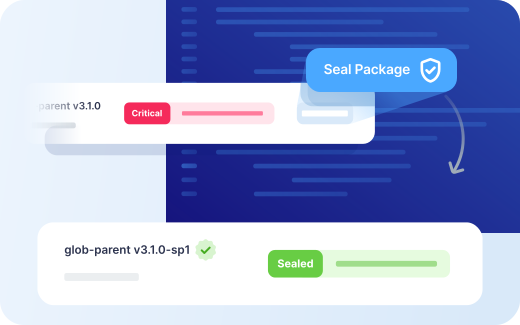
The core workflow of Seal Security hinges upon its integration with build pipelines or directly with artifact servers. Users can seamlessly integrate the tool into their existing processes, allowing it to automatically swap known vulnerable libraries with secure, sealed counterparts as part of the build process. After these vulnerabilities are addressed, organizations can maintain their regular release process—build, test, and deploy—as usual. Additionally, Seal Security constantly monitors the applications, ensuring they remain compliant with the latest security patches, and mitigating drift in the security posture over time. This autonomous remediation is individually governed, meaning every fix is both visible and subject to human approval before being deployed.
One of the standout advantages of the AppSec Remediation Agent is its capability to handle numerous scenarios that traditional security systems struggle with. For instance, it can secure transitive dependencies, end-of-life libraries, and legacy systems marked as “no fix available” by regular scanners. This wide-reaching functionality allows organizations to patch now without the immediate necessity for risky upgrades, thus providing teams with the flexibility to improve app security based on their preferred timelines. Companies like PayPal and Kiteworks have reported substantial time savings and operational efficiencies post-implementation, indicating that genuine human-vetted fixes can lead to significant improvements in development velocity and security posture.
The AppSec Remediation Agent is particularly beneficial for organizations governed by strict compliance regulations such as FedRAMP, PCI DSS 4.0, and NYDFS. Its patches are designed to be human-readable, enabling organizations to ensure that they continuously meet remediation SLAs without incurring difficulties during audits. Furthermore, the seamless integration of the solution into various environments, including containers, VMs, and bare metal, guarantees that security measures can operate across the entire Linux infrastructure effectively.
While the AppSec Remediation Agent presents a compelling offering in the realm of security solutions, organizations should also be aware of certain limitations and considerations. The tool may initially require some level of integration effort, particularly for teams not accustomed to automated security solutions. Additionally, continuous reliance on human-vetted patches means that organizations must ensure they have adequate personnel to review and approve fixes to leverage the full benefits offered by Seal Security. Moreover, organizations that have unique legacy environments might face constraints if they are using particularly obscure programming languages or outdated systems not fully supported by the platform.
Who it's for
What Seal Security can do
8 capabilities, verified from the product.
- Automates patching of open source vulnerabilities
- Human-vetted patches for reliability
- Supports transitive dependencies and legacy code
- Seamless integration with build pipelines
- Compliance-ready with human-readable patches
- Maintains control with visible, reviewable fixes
- No vendor lock-in for sealed libraries
- Single CLI command for operation
Jobs people hire it for
- 01Address critical open source vulnerabilities during development
- 02Ensure compliance with security regulations
- 03Remediate legacy application vulnerabilities
- 04Patch end-of-life libraries without major system upgrades
- 05Automate the patching workflow for faster delivery
Pros & cons
Where it shines
- Provides human-vetted, production-ready fixes which enhance reliability
- Enables teams to patch vulnerabilities without needing immediate upgrades
- Streamlines integration with existing build processes and systems
- Facilitates compliance with stringent regulatory standards effortlessly
- Eliminates vendor lock-in for patches, ensuring flexibility in usage
Where it falls short
- Initial integration may require personnel with technical expertise
- Teams must ensure adequate staffing for reviewing patches
- May not support very niche legacy systems or languages
- Continual reliance on human approval can slow down immediate response times
- Some organizations may experience a learning curve with automated processes
Pricing
See the official website for current pricing. Pricing can change — always confirm on the vendor's site.
Frequently asked about Seal Security
What is Seal Security?
Seal Security’s AppSec Remediation Agent is a tool that identifies and resolves open source vulnerabilities by providing human-vetted, production-ready patches, ensuring that teams can proceed with development without security delays.
What is Seal Security’s SLA for new vulnerabilities?
Seal Security maintains compliance with 72-hour remediation SLAs, allowing organizations to stay aligned with security requirements and industry standards.
What regulations does Seal Security help organizations support?
The solution assists organizations in adhering to various regulations including FedRAMP, PCI DSS 4.0, and NYDFS, ensuring compliance with stringent security measures.
What programming languages does Seal Security support?
The specific programming languages supported by Seal Security are not detailed on the page, but it is designed to address vulnerabilities in open source libraries and dependencies.
What integrations does Seal Security support?
No specific integrations are mentioned on the page, but it integrates directly with build pipelines and artifact servers.
What Linux operating systems does Seal Security support?
While the page does not specify individual Linux distributions, Seal Security is designed to secure applications across Linux infrastructure, including handling end-of-life environments.
What compliance certifications does Seal Security have?
The page does not list specific compliance certifications, but it positions itself as compliant with various industry standards such as FedRAMP and PCI DSS 4.0.
Ready to try Seal Security?
1,981 people checked it out on the directory — see it in action on the official site.
Keep exploring
Similar tools in Coding & DevTools
 Coding & DevTools
Cursor
The AI-first code editor — chat with your codebase and let agents write multi-file changes.
 Coding & DevTools
GitHub Copilot
Your AI pair programmer — code completions, chat, and agents inside your editor.
 Coding & DevTools
v0
Vercel's AI that turns prompts into production-ready React and Next.js UI.
 Coding & DevTools
E2B
The Enterprise AI Agent Cloud for secure AI workflows