
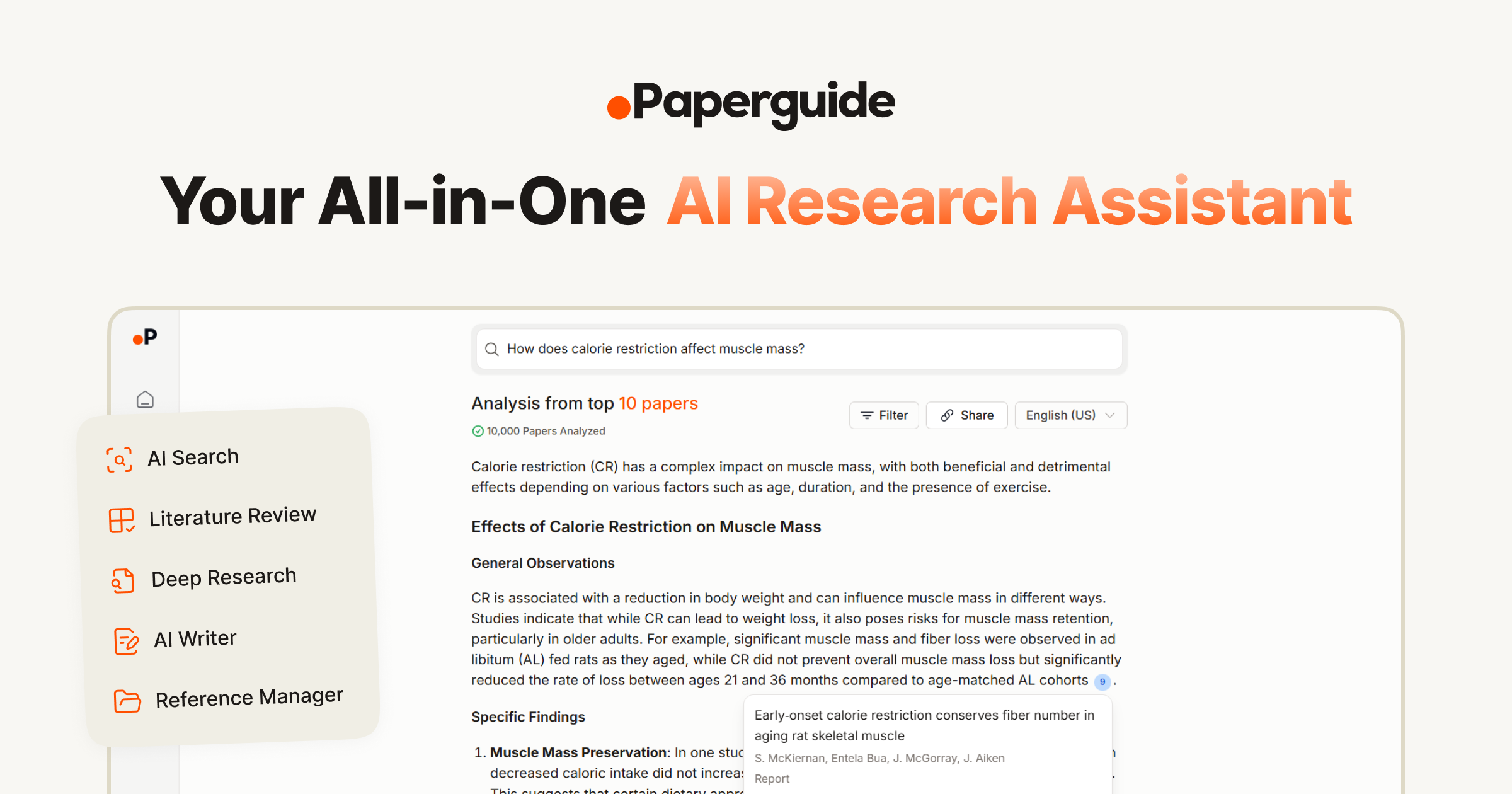
What is Paperguide?
Paperguide is an innovative AI research assistant designed to enhance the academic research experience by providing users with powerful tools for finding, analyzing, and managing research papers. It addresses the common challenges faced by researchers, students, and academics—namely, the overwhelming volume of literature and the time-consuming process of literature review and data extraction. With Paperguide, users can efficiently get research-backed answers, streamline the literature review process, manage references seamlessly, and even write academic documents. This all-in-one solution is tailored to fit myriad needs across different disciplines, including healthcare, science, and social sciences.
The core workflow of Paperguide revolves around its AI-powered search capabilities that allow users to find relevant research papers effortlessly. Users input their questions, and the AI analyzes millions of academic papers to deliver comprehensive answers, complete with proper citations. Instead of relying on conventional keyword searches, Paperguide utilizes a question-based model that comprehensively understands user queries. Additionally, users can perform literature reviews with an automated data extraction feature, which allows for comparison of multiple papers through structured summaries, making it simpler to discover key insights.
Among Paperguide's standout capabilities is its deep research report feature. This capability transforms what would typically take weeks of manual review into a matter of minutes. The AI not only uncovers relevant papers but also analyzes research trends, contradictions, and consensus within a field. Furthermore, Paperguide generates comprehensive reports that include structured sections, enhancing the user’s ability to synthesize knowledge effectively.
The platform includes a robust AI writing assistant that aids users in drafting and polishing their academic content. This tool eliminates writer's block, facilitating the generation of complete drafts built upon the user’s references while ensuring the maintenance of academic integrity through automatic citation management. Paperguide also integrates a reference management system, allowing users to import, organize, and collaborate on their references. Importing is flexible, supporting various formats including Zotero, BibTeX, and direct URLs, making it compatible with existing research workflows.
Target audiences for Paperguide include students, faculty, researchers, and professionals across various domains such as health economics, drug discovery, and clinical trial design. For example, clinical investigators might utilize Paperguide to design trials or develop protocols efficiently, while academic researchers can use it for literature reviews or meta-analyses. The intuitive design and personalized recommendations ensure that users can focus on insights rather than navigating complex literature tools, effectively increasing productivity and research quality.
In comparison to traditional reference managers like Zotero and Mendeley, Paperguide offers advanced functionalities that allow for deeper engagement with research materials, including chat capabilities with PDF documents. However, while Paperguide is powerful, some users might find it comes with a learning curve due to the depth of its features. This means that while gaining access to invaluable insights and streamlined workflows, researchers might need to invest time upfront to become proficient with the platform.
Overall, Paperguide provides a powerful, AI-backed framework for academic research that saves time and enhances the quality of literature engagement, making it an indispensable tool in the modern research landscape.
Who it's for
Works with
What Paperguide can do
8 capabilities, verified from the product.
- AI-powered paper search
- Question-based search for research queries
- Automated data extraction from key papers
- In-depth analysis of research trends
- Creation of comprehensive research reports
- AI writing assistant for academic content
- Streamlined reference management
- Real-time collaboration on references
Jobs people hire it for
- 01Conduct effective literature reviews in minutes
- 02Generate academic documents with ease using references
- 03Analyze data from multiple papers side by side
- 04Extract and compare key findings across research papers
- 05Quickly generate insights from large datasets
Pros & cons
Where it shines
- Enhances research efficiency with advanced AI tools
- Automates complex data extraction processes
- Supports multiple reference formats for easy integration
- Provides comprehensive insights and academic reports quickly
Where it falls short
- Potential learning curve for new users
- May not replace all features of specialized tools
- Requires an internet connection for full functionality
Pricing
Free tier available, specific premium features not detailed Pricing can change — always confirm on the vendor's site.
Frequently asked about Paperguide
Who is Paperguide designed for?
Paperguide is designed for a broad range of users including students, researchers, faculty, and professionals across various fields such as health economics, drug discovery, and clinical trial design. It caters to anyone needing to efficiently handle academic research and literature.
Which scientific databases do you search?
Paperguide searches an extensive database comprising over 200 million academic papers in multiple disciplines including life sciences, academia, and more, enabling comprehensive and relevant results for user queries.
How can I get in touch with your team?
For inquiries or support, users can visit the Paperguide website and access contact options available in their support or help section.
Do you use full texts or just abstracts?
Paperguide utilizes both full texts and abstracts for its AI analyses, ensuring comprehensive insights by working with complete research data to extract vital information.
How does Paperguide compare to traditional reference managers like Zotero or Mendeley?
Unlike traditional reference managers, Paperguide offers advanced AI capabilities for data extraction, insights generation, and facilitating literature reviews, making it a more robust tool for researchers needing in-depth analysis.
How accurate are the AI-generated summaries?
The AI-generated summaries are designed to be accurate and are supported by direct quotations from original research papers, allowing users to verify findings against the source material.
Does Paperguide use my personal data or uploaded content to train AI models?
Paperguide does not use personal data or uploaded content to train its AI models, ensuring user privacy and data security throughout its operations.
Do you support OCR PDFs?
There is no specific mention of OCR PDFs on the Paperguide page, so users may need to refer to the support team for inquiries regarding this feature.
Ready to try Paperguide?
1,043 people checked it out on the directory — see it in action on the official site.
Keep exploring
Similar tools in Writing & Content
 Writing & Content
Grammarly
AI writing assistance everywhere you type — grammar, tone, clarity, and full rewrites.
 Writing & Content
Notion AI
AI built into your workspace — write, summarize, and answer questions across all your docs.
 Writing & Content
Jasper
The AI marketing platform for on-brand content at scale — campaigns, blogs, and copy.
 Writing & Content
Plot Factory
An online story planner for creating, organizing, and writing stories.