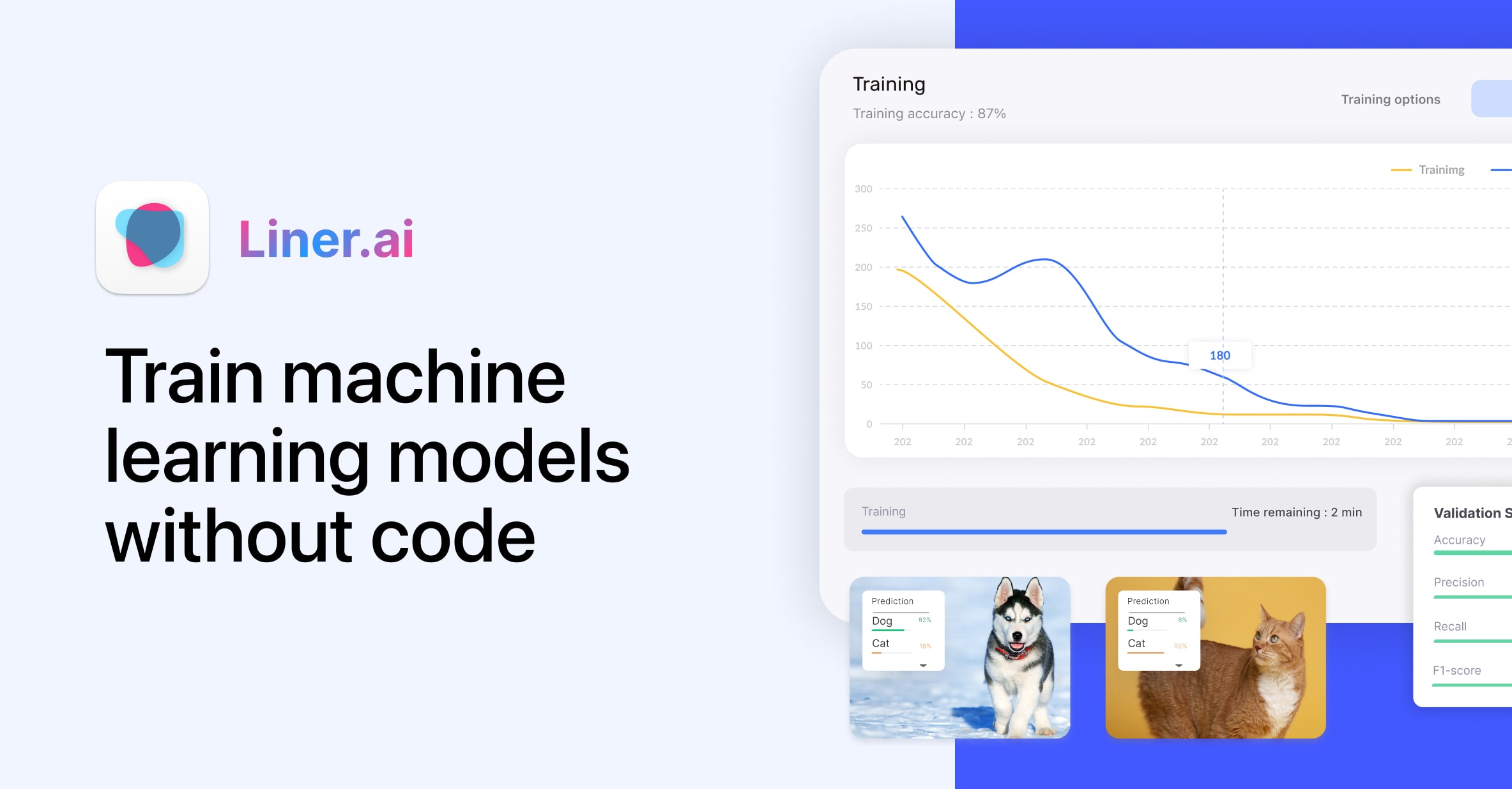
What is Liner.ai?
Liner.ai is a revolutionary tool designed to democratize access to machine learning by enabling users to build and deploy machine learning applications without any coding skills or prior expertise. Positioned as a free service, Liner addresses the common hurdles faced by developers and organizations when trying to leverage machine learning capabilities. Often, the complexities of setup, data management, and coding requirements deter many potential users. Liner simplifies these processes, allowing users to train their models in a matter of minutes using their data, thereby making AI accessible to a much wider audience.
At the core of Liner's functionality is its user-friendly workflow that allows anyone to create and train machine learning models through a structured, yet simplified three-step process. Users first import their data, which could be their own datasets or pre-labeled datasets from Liner's library. Following the import, users can quickly begin training by clicking a button, which triggers Liner to automatically select the most appropriate model and begin the training process. Once training is complete, users can easily deploy their models across various platforms, ensuring that the integration into existing systems is seamless.
Liner's standout capabilities are numerous and cater to various machine learning applications. It supports a diverse range of machine learning project types, including Image Classification, Text Classification, Audio Classification, Video Classification, Object Detection, Image Segmentation, and Pose Classification. This diversity not only showcases Liner's versatility but also helps users apply machine learning to a plethora of real-world scenarios in a straightforward manner. The platform optimizes training for speed and accuracy, using state-of-the-art models that are designed to perform efficiently on standard CPUs, eliminating the need for specialized hardware such as GPUs.
The tool is particularly valuable for non-technical users and teams who need to leverage machine learning for their projects but lack coding knowledge. Common scenarios where Liner shines include small business owners looking to classify customer feedback, educators wanting to analyze student submissions, or developers keen on prototyping machine learning applications without extensive investment in time or resources. Liner's intuitive interface allows users from various fields, including marketers, educators, and analysts, to harness the power of AI without the typical barriers of entry associated with machine learning.
In terms of positioning within the machine learning landscape, Liner competes with other no-code platforms but stands out due to its specific focus on providing an all-in-one tool that integrates training and deployment seamlessly. Unlike other tools that may require some level of technical expertise or offer only specific functionalities, Liner combines ease of use with extensive features, making it a robust option for users at all experience levels. This blend of accessibility and capability is where Liner truly excels.
However, there are limitations to consider. While Liner is quite powerful, the diversity of project types may not cover specialized or highly complex machine learning needs that require bespoke coding or advanced techniques. Additionally, users who want to scale their models beyond basic deployments may eventually hit a ceiling with Liner's capabilities, especially in highly technical domains where customization and nuanced model training are pivotal. Furthermore, being a tool that runs entirely locally increases data privacy but also means that users must have their systems adequately equipped and maintained.
Who it's for
What Liner.ai can do
8 capabilities, verified from the product.
- Train machine learning models without writing code
- Integrate models easily with applications
- Supports multiple project types like image and text classification
- Optimized for speed and accuracy on CPUs
- Pre-labeled dataset access available
- Export trained models to various platforms
- Community support for feature requests
- Data privacy with local training only
Jobs people hire it for
- 01Classify customer feedback for better service insights
- 02Analyze educational submissions for grading automation
- 03Create custom image classifiers for marketing materials
- 04Develop audio classifiers for sound recognition tasks
- 05Implement video classification for content moderation
Pros & cons
Where it shines
- Intuitive interface that requires no machine learning expertise
- Fast model training on standard CPUs, no GPU needed
- Supports a wide range of machine learning projects
- Completely free, making it accessible for all users
- Offers privacy as training and data management happens locally
Where it falls short
- May not support highly specialized machine learning needs
- Limited advanced features compared to more technical ML platforms
- Local training requires users to have capable hardware
- Dependency on user-provided datasets may limit some use cases
- Scalability might be a concern for enterprise applications
Pricing
Completely free to use with no hidden costs Pricing can change — always confirm on the vendor's site.
Frequently asked about Liner.ai
What does Liner.ai do?
Liner.ai is a tool that allows users to build and deploy machine learning applications without any coding or machine learning expertise required. Users import their training data, choose the type of model they want to create, and train it in an easy-to-follow process.
Is there a free trial?
Liner.ai is completely free to use. There are no trials or hidden costs; users can take full advantage of the tool at no expense.
What kind of data can I use to train models?
Users can import their datasets into Liner.ai or utilize a library of pre-labeled datasets provided by the platform, enabling flexibility in training models based on various needs.
Do I need a GPU to train models with Liner.ai?
No, Liner.ai is designed to train models efficiently on standard CPUs, so a GPU is not required. This makes it accessible for users who may not have sophisticated hardware.
How does Liner.ai ensure data privacy?
Data privacy is a key aspect of Liner.ai; all training occurs locally on the user's computer, meaning that the data never leaves the system and is not sent to the cloud.
Who is Liner.ai best suited for?
Liner.ai is ideal for users without coding experience who want to leverage machine learning in their projects. This includes business owners, educators, marketers, and data analysts.
What types of machine learning projects can I create?
Liner supports a variety of machine learning project types including image classification, text classification, audio and video classification, object detection, image segmentation, and pose classification.
Where can I download Liner.ai?
Liner.ai is available for download on both Windows and Mac platforms, catering to a broad user base.
Ready to try Liner.ai?
1,203 people checked it out on the directory — see it in action on the official site.
Keep exploring
Similar tools in Coding & DevTools
 Coding & DevTools
Cursor
The AI-first code editor — chat with your codebase and let agents write multi-file changes.
 Coding & DevTools
GitHub Copilot
Your AI pair programmer — code completions, chat, and agents inside your editor.
 Coding & DevTools
v0
Vercel's AI that turns prompts into production-ready React and Next.js UI.
 Coding & DevTools
E2B
The Enterprise AI Agent Cloud for secure AI workflows