
- Views
- 2,496
- Upvotes
- 227
- Launched
- —
What is crawler.sh?
crawler.sh is a robust local crawler designed to transform websites into clean, ready-to-use Markdown formats suitable for training AI models and enriching retrieval-augmented generation (RAG) pipelines. By providing a way to extract content efficiently without the overhead of cloud services or per-page fees, it addresses the needs of developers, data scientists, and content engineers who require high-quality textual data. It offers a local execution environment, ensuring data privacy and eliminating the need for third-party services, which is ideal for organizations handling sensitive information.
At its core, crawler.sh utilizes a custom JavaScript rendering engine that effectively processes single-page applications (SPAs) built with frameworks such as React, Vue, and Next.js. This means that unlike traditional crawlers which may rely on headless Chrome, this tool can handle dynamic content seamlessly, rendering the JavaScript required to display full-page content. It simulates user interactions in a way that authentically reflects the user’s experience on the website, which is crucial for extracting properly formatted Markdown.
One of the standout features of crawler.sh is its polite crawling behavior. It respects directives set in a website's robots.txt file, ensuring that it only accesses allowable content while adhering to rules such as "Disallow" and "Allow". This helps users avoid ethical dilemmas related to web scraping and ensures compliance with various website policies. Furthermore, its adaptive pacing when encountering 429 (Too Many Requests) and 403 (Forbidden) responses provides efficiency during data extraction. The tool gradually decreases its request rate, minimizing the risk of being blocked by the website being scraped.
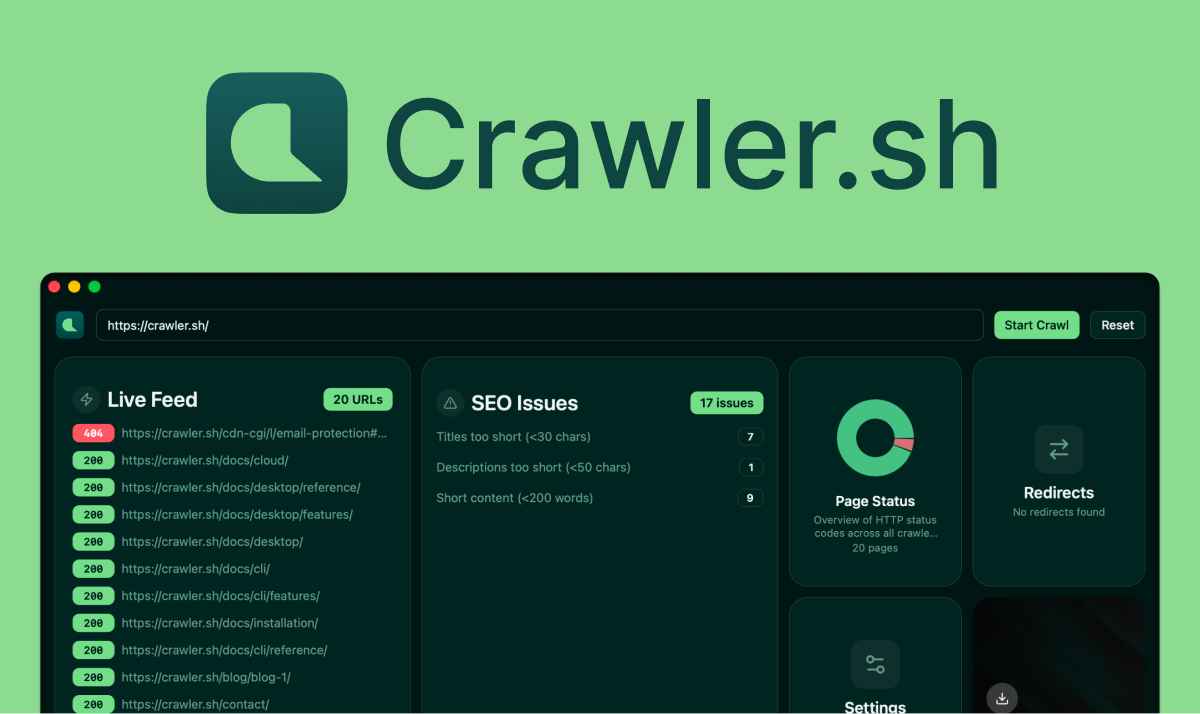
For those involved in SEO, crawler.sh offers automated checks for a variety of key elements that are vital in website optimization. By running basic audits, users can identify issues like missing titles, duplicate meta descriptions, and thin content, making it an excellent tool for both SEO professionals and content strategists. The ability to export these findings as CSV or TXT files further streamlines the process of monitoring website health and preparing for content launches.
The use cases for crawler.sh are vast. It is particularly well-suited for content archiving, where users can extract clean Markdown from websites effectively for backup or migration purposes. SEO auditing is another primary use case, enabling users to proactively manage their website’s health. Additionally, users can generate W3C-compliant sitemaps from live crawls with ease, maintaining accurate site maps without cumbersome manual updates. Regular site monitoring can be managed via this tool, alerting users to broken links, missing pages, and status code changes, thereby enhancing overall website maintenance efforts.
While crawler.sh provides a wealth of functionalities, it is important to note some limitations. First, the learning curve might be daunting for those unfamiliar with command-line tools or technical setups. Additionally, while it excels in extracting content, the tool’s performance may vary depending on the complexity of the website being crawled, particularly those utilizing heavy client-side rendering. Lastly, the reliance on local resources may limit scalability for very large crawls, which may require additional configurations to manage resource limitations efficiently.
Who it's for
What crawler.sh can do
8 capabilities, verified from the product.
- Extract clean Markdown from websites
- Custom JavaScript rendering engine
- Respects robots.txt directives
- Automated SEO checks and reports
- Exports issues as CSV or TXT
- Generates W3C-compliant Sitemap XML
- Adaptive pacing based on responses
- Bulk export entire sites as archives
Jobs people hire it for
- 01Create RAG-ready datasets for AI training
- 02Conduct SEO audits prior to site launch
- 03Extract and archive web content for backups
- 04Generate real-time sitemaps for SEO purposes
- 05Monitor website health and link status regularly
Pros & cons
Where it shines
- Operates locally, enhancing data privacy without cloud dependencies
- Handles dynamic content via a sophisticated rendering engine
- Polite crawling respects web scraping guidelines effectively
- Comprehensive SEO analysis provides robust auditing capabilities
- Flexible in use, fitting both AI training and SEO tasks
Where it falls short
- Requires familiarity with command-line interfaces
- Performance may be affected by the complexity of the targeted website
- Limited scalability for extensive crawls on low-resource machines
Pricing
Free to download and use Pricing can change — always confirm on the vendor's site.
Frequently asked about crawler.sh
What is crawler.sh used for?
crawler.sh is a local tool designed to extract content from websites and convert it into clean, RAG-ready Markdown. It is tailored for AI training and fine-tuning purposes, making it suitable for developers and data scientists who need quality data without relying on cloud services.
Does crawler.sh run in the cloud or locally?
crawler.sh operates locally on your machine, which means it does not involve cloud processing, thus ensuring enhanced data privacy and eliminating per-page fees.
How does crawler.sh handle JavaScript-heavy websites?
The tool employs a custom JavaScript rendering engine that can manage single-page applications (SPAs) built with frameworks like React and Vue, allowing it to extract the full content effectively without needing headless Chrome.
What features does the SEO analysis provide?
The SEO analysis in crawler.sh includes automated checks for missing titles, duplicate meta descriptions, thin content, broken links, long URLs, and content freshness signals. Issues detected can be exported in CSV or TXT formats for further review and action.
Is there any cost associated with using crawler.sh?
crawler.sh is completely free to download and use, providing users with a powerful web crawling solution without any financial overhead.
What platforms does crawler.sh support?
crawler.sh is compatible with Windows, macOS, and Linux operating systems, making it accessible to a broad range of users.
Who can benefit from using crawler.sh?
Various professionals, including data scientists, content engineers, and SEO specialists, can benefit from crawler.sh due to its data extraction capabilities and thorough SEO auditing features.
What are the limitations of crawler.sh?
Some limitations include a steep learning curve for users unfamiliar with command-line tools, potential performance issues with complex sites, and restrictions on scalability for large crawls, which could impact processing speed.
Ready to try crawler.sh?
2,496 people checked it out on the directory — see it in action on the official site.
Keep exploring
Similar tools in Data & Analytics
 Data & Analytics
Unlearn
Streamlining clinical trials with AI and digital twins of patients.
 Data & Analytics
ora
Evaluate your business's readiness for AI agents across multiple layers.
 Data & Analytics
Gong Revenue AI OS
AI-powered platform for enhancing sales team efficiency and effectiveness.
.jpg) Data & Analytics
Data & AnalyticsLido
Extract Data from PDFs, Invoices & Receipts to Excel