
CoCounsel
Fiduciary-Grade AI technology for high-stakes professionals
What is CoCounsel?
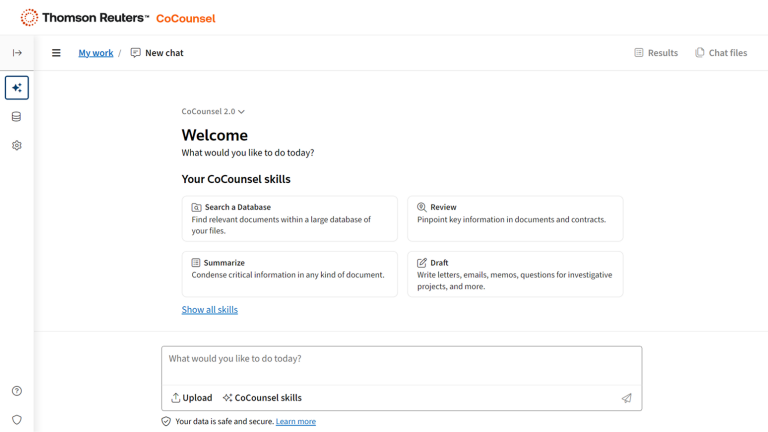
CoCounsel, developed by Thomson Reuters, is an advanced AI solution specifically crafted for professionals in high-stakes environments such as legal, tax, auditing, and compliance sectors. Unlike generic AI systems that primarily enhance speed, CoCounsel aims to improve the reliability and defensibility of professional work. It is built on a foundation of authoritative content and expert-validated sources, ensuring that its output is not only rapid but also deeply informed and trustworthy. This makes it an ideal tool for professionals who cannot afford inaccuracies in their work, providing them with a supportive framework that emphasizes both speed and precision.
The workflow with CoCounsel begins with professionals posing queries or uploading relevant documents into the system. The AI processes this input by retrieving information from its vast repository of authoritative sources, ensuring that the answers originate from credible and validated materials. This process is further enhanced by integrations with tools that professionals commonly use, including Westlaw and Microsoft 365, allowing for a seamless experience that minimizes disruptions to existing workflows. Importantly, CoCounsel emphasizes transparency by providing sources for its recommendations and reasoning, enabling users to verify and validate the AI’s inputs easily.
One of CoCounsel's standout capabilities is its unique focus on Fiduciary-Grade AI, which aligns with the highest standards required in professional settings. This distinction means that the AI is tailored to account for the nuances and complexities of professional responsibilities, providing outputs that can influence legal decisions, regulatory filings, and critical financial disclosures. Additionally, the integration of robust security measures ensures that sensitive data remains protected throughout the usage of the platform, making it a trustworthy choice for firms handling confidential information. This security includes encryption protocols and zero-retention policies to safeguard user data.
CoCounsel is targeted at a variety of professional users, including legal practitioners, tax professionals, auditors, and accountants, among others. It is particularly beneficial in settings where time efficiency directly impacts service delivery and client satisfaction. For example, law firms can leverage CoCounsel to rapidly draft briefs or conduct legal research, significantly reducing the time it takes to produce quality work. Similarly, tax firms can utilize the AI to streamline compliance processes, quickly accessing the latest regulations and guidance tailored to their needs.
In comparison to other AI tools in the market, CoCounsel's emphasis on fiduciary duties sets it apart. While many AI products excel in general productivity tasks, CoCounsel specializes in high-stakes professional outputs. This focus on accuracy and accountability attracts firms that demand accountability from their tools, capitalizing on the ability to deliver work that meets rigorous standards of scrutiny. This specialization means CoCounsel is not just a productivity enhancer but a trusted advisor that assists professionals in making informed decisions.
However, despite its many advantages, CoCounsel does have limitations. For instance, it is designed to supplement, not replace, human judgment. Professionals are still responsible for the outcomes of their work, which can create a level of dependency on human oversight. Additionally, there is a learning curve associated with effectively integrating CoCounsel into existing workflows, which may require time investments and training. Finally, the exclusive focus on high-stakes professionals may alienate smaller firms or freelance workers who typically don't engage in such rigorous professional contexts.
Who it's for
Works with
What CoCounsel can do
8 capabilities, verified from the product.
- Fiduciary-Grade AI for decision support
- Integrates with Westlaw and Microsoft 365
- Authoritative source retrieval for answers
- Real-time validation by subject-matter experts
- Enterprise-grade security and privacy controls
- Transparent outputs with verifiable reasoning
- Customizable data retention policies
- Zero-retention API calls for data security
Jobs people hire it for
- 01Draft legal briefs quickly and accurately
- 02Conduct rapid legal research and due diligence
- 03Streamline compliance processes for tax filings
- 04Enhance data management in auditing tasks
- 05Provide authoritative advice for financial disclosures
Pros & cons
Where it shines
- Offers outputs grounded in authoritative content, enhancing reliability
- Designed for high-stakes environments where mistakes are costly
- Seamless integration with widely used professional tools ensures efficiency
- Robust security protocols protect sensitive customer data
- Real-time validation and input from subject-matter experts build trust
Where it falls short
- Not a substitute for professional judgment; human oversight is needed
- Potential learning curve for new users integrating it into workflows
- May not cater to lower-stakes or smaller-scale professional tasks
- Lack of pricing transparency may deter potential users
Pricing
See the official website for current pricing. Pricing can change — always confirm on the vendor's site.
Frequently asked about CoCounsel
What is CoCounsel and what problem does it solve?
CoCounsel is an AI-driven tool designed for professionals in high-stakes sectors like law, tax, and compliance. It helps users produce reliable, defensible work grounded in authoritative content and expert validation, which is essential in professions where accuracy is critical.
How does CoCounsel work?
Users can input queries or documents into CoCounsel, which then retrieves relevant information from its authoritative databases. It integrates with familiar tools and emphasizes transparency by providing sources and reasoning behind its outputs.
What makes CoCounsel's AI different from general AI tools?
CoCounsel features Fiduciary-Grade AI that specifically addresses the needs of professionals with regulatory oversight and care responsibilities, creating outputs that are tailored for high-stakes decision-making.
Can CoCounsel replace professional judgment?
No, CoCounsel is designed to support human judgment rather than replace it. Professionals are ultimately responsible for the decisions and advice they provide.
How does Thomson Reuters protect user privacy and data?
CoCounsel employs rigorous security measures, including data encryption during transmission and at rest. Additionally, user content is not used to train third-party models and is retained only based on customizable retention policies.
Does CoCounsel retain user-generated content?
User content and prompts are retained based on the organization’s needs and can be deleted at any time according to the organization's retention policy.
Who is the primary audience for CoCounsel?
CoCounsel is ideal for legal, tax, audit, and accounting professionals who require a trustworthy system that supports high-stakes decision-making processes.
What integrations does CoCounsel offer?
CoCounsel integrates with major professional tools such as Westlaw, Practical Law, Checkpoint, and Microsoft 365, facilitating a seamless user experience.
Ready to try CoCounsel?
1,535 people checked it out on the directory — see it in action on the official site.
Keep exploring
Similar tools in Writing & Content
 Writing & Content
Grammarly
AI writing assistance everywhere you type — grammar, tone, clarity, and full rewrites.
 Writing & Content
Notion AI
AI built into your workspace — write, summarize, and answer questions across all your docs.
 Writing & Content
Jasper
The AI marketing platform for on-brand content at scale — campaigns, blogs, and copy.
 Writing & Content
Plot Factory
An online story planner for creating, organizing, and writing stories.