AdaL
The best coding agent for teams and high-performing engineering workflows.
- Views
- 1,206
- Upvotes
- 266
- Launched
- —
What is AdaL?
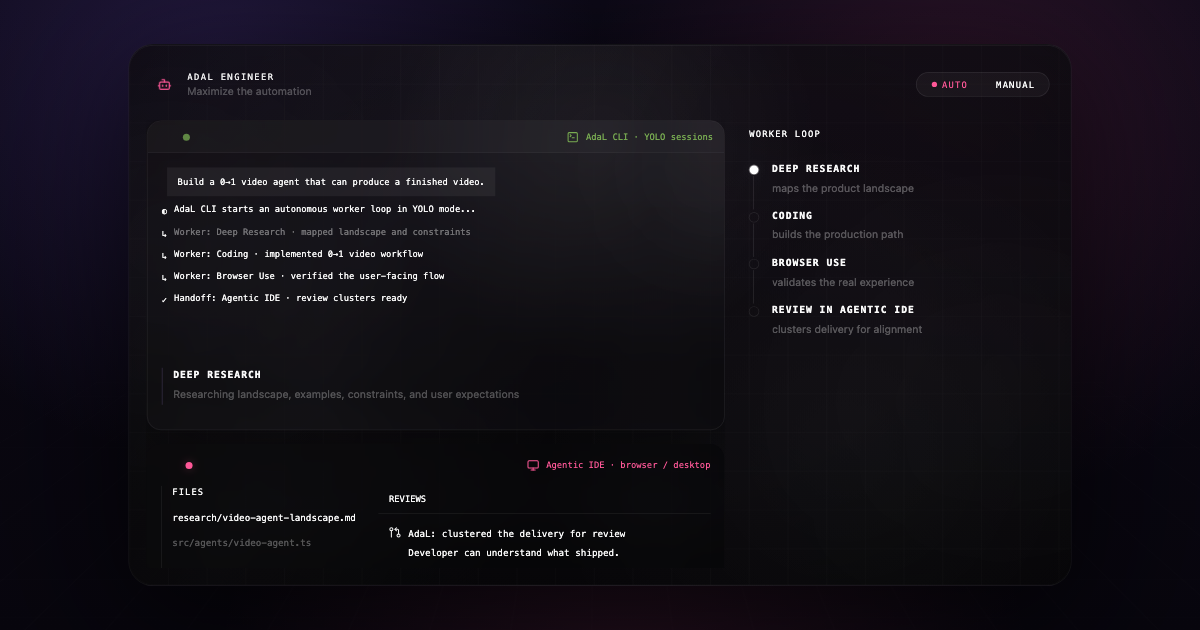
AdaL is a cutting-edge multi-agent engineering system designed specifically for teams that aim to enhance productivity and streamline workflows in coding, research, and other technical tasks. It addresses the often cumbersome and time-consuming responsibilities associated with software development by automating various processes through high-trust Worker Agents and a dedicated Engineer Agent. This innovative approach not only reduces the workload of human engineers but also accelerates project timelines and improves overall team efficiency.
The core functionality of AdaL revolves around its multi-agent architecture, which includes Worker Agents capable of performing coding tasks, conducting research, browsing the web for information, and engaging in code reviews. Each Worker Agent is equipped with advanced capabilities that enable them to function autonomously and support human engineers in their tasks, thereby minimizing micromanagement and allowing engineers to focus on higher-level problem-solving and strategic initiatives. The presence of the Engineer Agent serves a crucial role in overseeing these Worker Agents, managing their activities, and thereby “taking babysitting off your hands.” This separation of tasks means that human engineers can think creatively and focus on innovation rather than getting bogged down by routine tasks.
One of the standout features of AdaL is its ability to foster high-trust interactions between its Worker Agents and the team. This trust is built through a combination of successful outcomes, reliability in task execution, and the system’s ability to learn and adapt over time. Such capabilities are particularly vital in environments where accuracy and efficiency are paramount. Organizations can expect faster completion of code-related tasks, enhanced quality in outputs, and seamless integration of technology into their existing workflows.
The target audience for AdaL includes software development teams, research organizations, and any groups involved in technical projects that require collaboration and efficiency. Typical scenarios where AdaL shines include coding new software features, conducting necessary research to inform development decisions, browsing up-to-date resources for code optimization, and participating in peer reviews to uphold coding standards. Essentially, teams can harness AdaL to cut down on project lifecycles, allowing them to deliver results more swiftly and with fewer resources expended.
In the realm of multi-agent systems, AdaL holds a competitive edge through its focus on trust and automation tailored for technical environments. While many alternatives may offer coding assistance or project management functionalities individually, AdaL’s integrated approach enables a cohesive user experience. Teams looking for a comprehensive solution to improve coding workflows and project management will find AdaL particularly appealing, as it uniquely combines worker autonomy with oversight, ensuring that human strengths are leveraged where they matter most.
However, potential users should also consider some limitations. First, the success of AdaL heavily relies on the actual implementation of the Worker Agents and their integration into existing workflows. If teams are not prepared to adapt to new technological methods or rely on automated systems, the desired productivity improvements may not materialize. Additionally, while AdaL’s focus is on coding and related tasks, teams needing a more general-purpose tool for diverse other functions may find it less appealing. Lastly, as with any automated system, there might be instances where human intuition cannot be fully replicated, thus requiring users to remain engaged in critical decision-making processes to complement the automated suggestions and outputs from AdaL’s agents.
Who it's for
What AdaL can do
8 capabilities, verified from the product.
- High-trust Worker Agents for coding
- Dedicated Engineer Agent for oversight
- Automation of coding tasks
- Research capabilities through browsing
- Support for peer code reviews
- Task management to reduce babysitting
- Enhanced team productivity
- Integration into existing workflows
Jobs people hire it for
- 01Automate routine coding tasks to speed up development
- 02Conduct research to aid software feature development
- 03Utilize web browsing capabilities for documentation access
- 04Engage in code reviews efficiently with automated assistance
- 05Streamline project timelines through task delegation
Pros & cons
Where it shines
- Significantly reduces the workload on human engineers by automating mundane tasks
- Enhances overall team productivity with high-trust interactions
- Specializes in coding workflows, making it adept for development teams
- Facilitates faster project timelines through efficient task management
Where it falls short
- Implementing the system may require a cultural shift within teams
- If teams do not adapt to automation, benefits may not be realized
- Primarily focused on coding tasks, less suitable for non-technical roles
- Dependence on technology may lead to gaps in human decision-making
Pricing
See the official website for current pricing. Pricing can change — always confirm on the vendor's site.
Frequently asked about AdaL
What is AdaL?
AdaL is a multi-agent engineering system designed to enhance team productivity through high-trust Worker Agents that perform coding, research, browser use, and code reviews, along with an Engineer Agent that manages these processes.
Who is AdaL for?
AdaL is primarily aimed at software development teams, research organizations, and any groups working on technical projects that require enhanced collaboration and efficiency in coding and related tasks.
What are the main features of AdaL?
AdaL offers high-trust Worker Agents that automate coding tasks, an Engineer Agent for task oversight, research browsing capabilities, support for peer code reviews, and overall enhanced productivity in engineering workflows.
How does AdaL improve productivity?
By automating routine tasks, reducing micromanagement through delegation to Worker Agents, and enabling teams to focus on more creative aspects of development, AdaL significantly speeds up project timelines and enhances workflow efficiency.
What are the limitations of using AdaL?
Users might face a steep learning curve adapting to this technology, and if the team does not embrace the automation process, they may not experience the full benefits. Additionally, it is primarily focused on coding tasks, which might not fit all team needs.
Is there a pricing model for AdaL?
The pricing model for AdaL is categorized under 'CONTACT,' indicating that potential users should reach out for detailed pricing information.
How does AdaL compare to other coding tools?
Unlike many coding tools that focus on individual functionalities, AdaL stands out by integrating multiple agents into a cohesive system, fostering collaboration while automating essential tasks for development teams.
Ready to try AdaL?
1,206 people checked it out on the directory — see it in action on the official site.
Keep exploring
Similar tools in Coding & DevTools
 Coding & DevTools
Cursor
The AI-first code editor — chat with your codebase and let agents write multi-file changes.
 Coding & DevTools
GitHub Copilot
Your AI pair programmer — code completions, chat, and agents inside your editor.
 Coding & DevTools
v0
Vercel's AI that turns prompts into production-ready React and Next.js UI.
 Coding & DevTools
E2B
The Enterprise AI Agent Cloud for secure AI workflows